Blog
Why Your Garage Door Jumps the Track in DeKalb
DeKalb's housing stock dates mostly to 1960s-70s builds and the area sits in a severe cold band - both push tracks out of alignment. Here's why, and how to check it.
Season by Season
A door that rolls smooth in July and binds in January isn't being dramatic - it's responding to temperature swings that are part of living in a severe cold climate band like this one. Steel track contracts when the mercury drops, and the tolerances between roller and rail get tighter. On an older track that's already bowed slightly from years of use, that tightening is enough to pop a roller loose at the first hard stop. Spring and fall bring their own problem: freeze-thaw cycles shift concrete slabs a fraction of an inch at a time, and if your slab has settled unevenly, the track bolted to the jamb no longer lines up with the track bolted to the framing. You won't see it happen in one day. You'll notice it as a door that used to glide now rattles on the way up, usually starting around the second or third panel. By midwinter, that rattle is a door that's already partly off the rail.
What Is Going On
Most of the housing stock in this service area went up between 1959 and 2009, with the bulk clustering in 1960s and '70s construction across the 22 named areas we work in. That matters here specifically: garages from that era were framed to the standards of their time, which often means tracks mounted directly to wood jambs that have since shrunk, twisted, or settled. A track that was plumb in 1976 is not necessarily plumb now. When the track leans even slightly out of vertical, the rollers ride against one edge of the rail instead of rolling centered in it. Over enough open-close cycles, that edge wear lets a roller walk itself right out of the channel, especially on the horizontal section near the ceiling where the door takes the sharpest bend. It's less a single cause than years of small drift finally showing up as a stuck or crooked door.
Checking It Yourself
Open the door about halfway and look at the gap between each roller and its track - it should be even on both sides from top to bottom. If one side pinches tight and the other has daylight, the track has shifted. Next, run a level against the vertical track sections; more than about a quarter inch of lean over the length of the track means the mounting has moved, not just the hardware. Listen for a scrape or grind right at the point where vertical track curves into horizontal - that's where rollers jump first. What we don't recommend is bending a track back into place yourself. Track steel work-hardens once it's bent, and a straightened section fails again faster than one replaced outright. If you find lean, loose bolts, or a roller already out of the channel, that's a call, not a DIY afternoon.
What the Weather Here Does to It
The severe cold classification for this area isn't just a label - it's the reason hardware fatigues faster than a mild-climate chart would suggest. Lubricant that's fine at 50 degrees turns gummy at 10, adding drag right when the steel track is already contracted tight against the rollers. That extra resistance is what finally pulls a worn roller stem loose or snaps a frayed cable, both of which can walk a door off track mid-cycle. Houses built in the 1976 median year for this area typically have single-car or narrow double garages with tracks sized for lighter doors than what's sometimes been installed since - a heavier replacement door on old, narrower track hardware is a mismatch that shows up as chronic misalignment, not a one-time fix. One honest limit: if the track itself is bent rather than just knocked loose, we replace that section rather than hammer it straight, because a reworked track won't hold alignment through another DeKalb winter.
Questions
Common questions
Why does my garage door only jump the track in winter?
Cold causes the steel track to contract while lubricant thickens, adding drag at the exact point rollers need to move freely. On a track that already has some lean from age or a settled slab, that extra resistance is often what finally pushes a roller out of the channel. It's rarely a coincidence that it happens in the cold months.
Can I just bend the track back myself?
We don't recommend it. Track steel work-hardens once it's bent out of shape, so forcing it back tends to create a weak point that fails again, usually sooner than the original problem. If a section is visibly bent rather than just loose at the mounts, replacing that section holds up better long term.
Is an off-track door always the track's fault?
No. Often the track is fine and the real cause is a worn roller stem, a loose mounting bracket, or an unevenly settled slab pulling the track frame out of plumb. That's why checking roller gap and track level matters before assuming the track itself needs replacing.
Recommendation
You Might Also Like
More garage door guides for DeKalb homeowners.
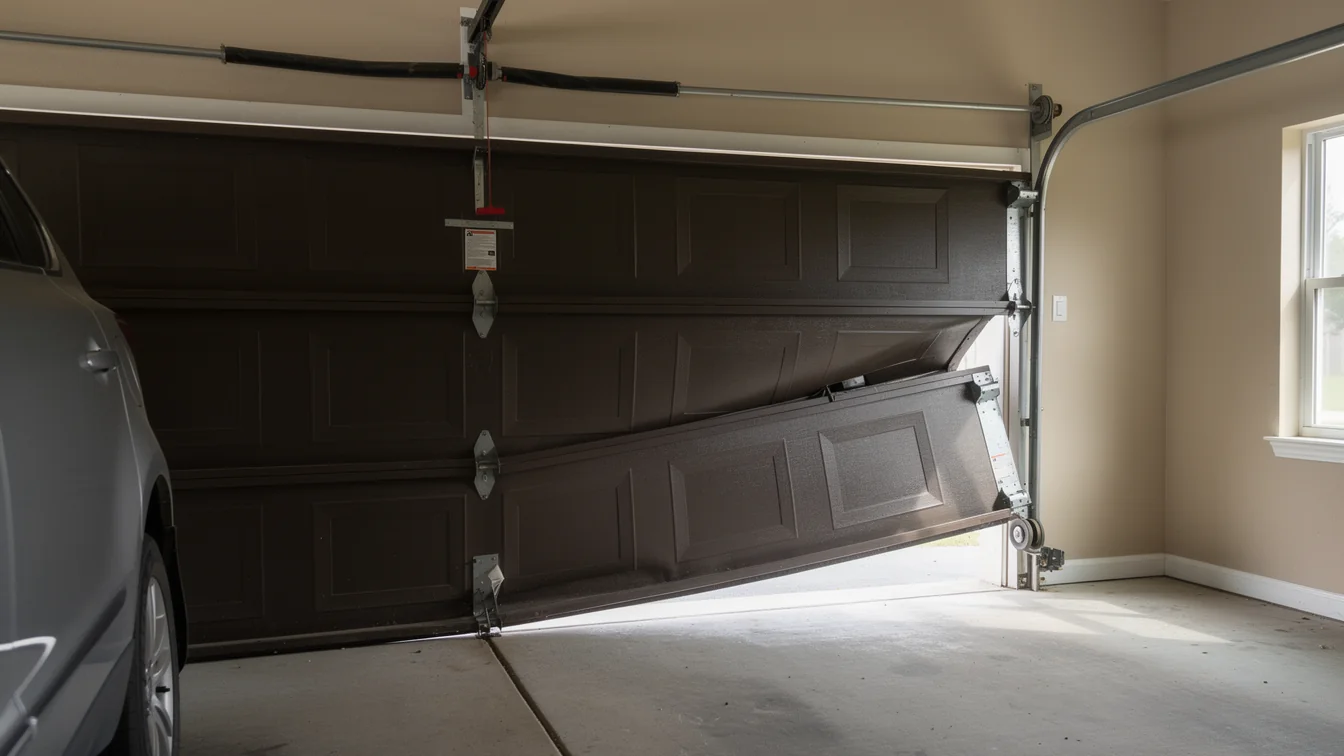 What DeKalb's Housing Age and Climate Mean for Your Garage Door
DeKalb's housing runs 1959 to 2009, median build year 1976, and the cold-severe climate band works differently on each era's hardware.
What DeKalb's Housing Age and Climate Mean for Your Garage Door
DeKalb's housing runs 1959 to 2009, median build year 1976, and the cold-severe climate band works differently on each era's hardware.
 Openers, Power Cuts, and the DeKalb Winter
How DeKalb's 1960s-70s housing stock and severe cold winters affect garage door openers and power cuts, plus what to check before you call for service.
Why Your DeKalb Garage Door Lets in Draughts
How DeKalb's cold winters and 1960s-70s housing stock wear out garage door seals, and what to check before the draughts cost you on heat.
Openers, Power Cuts, and the DeKalb Winter
How DeKalb's 1960s-70s housing stock and severe cold winters affect garage door openers and power cuts, plus what to check before you call for service.
Why Your DeKalb Garage Door Lets in Draughts
How DeKalb's cold winters and 1960s-70s housing stock wear out garage door seals, and what to check before the draughts cost you on heat.
Ready when you are
Need a garage door sorted in DeKalb?
DeKalb Garage Door Pros repairs and installs garage doors, springs and openers in DeKalb, IL and the surrounding area.